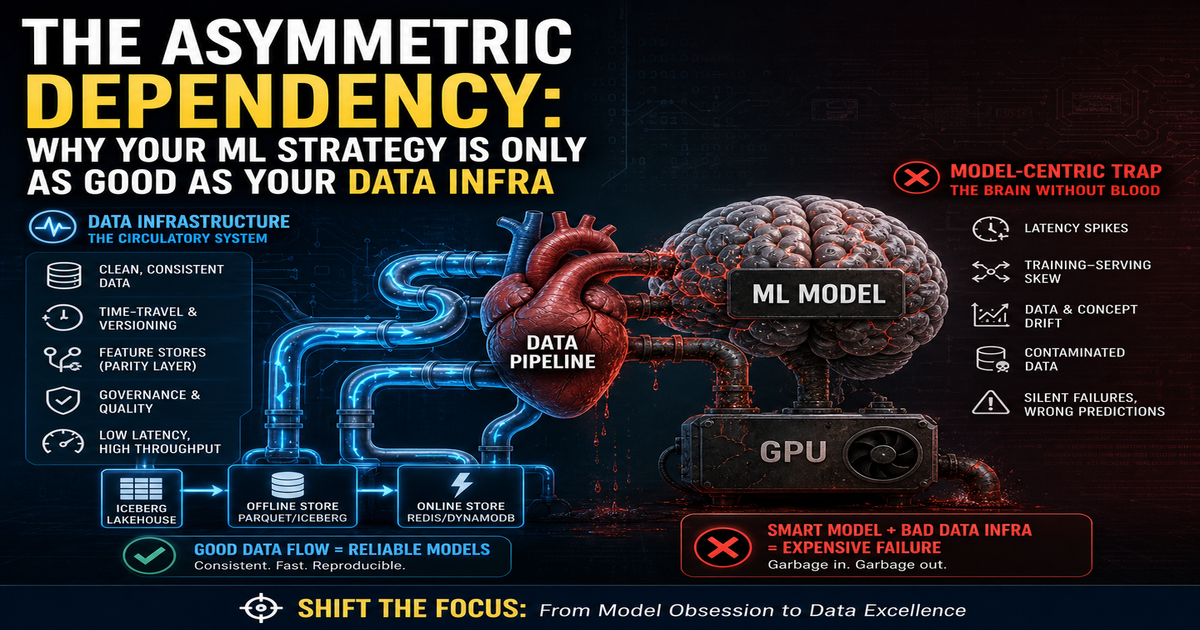
A team spends six months tuning a state-of-the-art Transformer model to 99% accuracy in a Jupyter notebook, only to watch it collapse in production. The culprit isn’t the architecture or the hyperparameters, it’s a 200ms latency spike in feature retrieval and a subtle training-serving skew that the model wasn’t built to handle.
This is the “Asymmetric Dependency”. We treat ML infrastructure (the GPUs, the orchestration, the model registry) as the brain of the operation. But the data infrastructure is the circulatory system. If the blood is contaminated or the flow is blocked, it doesn’t matter how smart the brain is. The system dies.
Most teams build their ML strategy upside down. They obsess over the model, treating the data pipeline as a “plumbing” problem to be solved by a few scripts and a prayer. In reality, your model’s just a mathematical reflection of your data infrastructure.
The Model-Centric Trap
We’ve been conditioned to believe that the “magic” happens in the model architecture. We track the latest papers on ArXiv, argue about attention mechanisms, and burn thousands of dollars in compute to shave 0.1% off a loss function.
This is the Model-Centric Trap.
It’s like putting a high-performance Formula 1 engine into a car running on contaminated fuel. You can tune the engine to perfection, but the moment you hit the track, the fuel injectors clog and the engine seizes. In ML, “contaminated fuel” is data that’s inconsistent, stale, or leaked from the future.
The most dangerous part of this trap is the “Notebook Success” mirage.
I’ve seen this play out dozens of times. A data scientist loads a static CSV into a notebook, performs a few groupby operations, and achieves a stunning F1 score. They present the results to leadership, the project is greenlit, and the “deployment” begins.
But in the notebook, the data was a frozen snapshot. In production, that data’s a living, breathing stream. The groupby that took three seconds on a 100MB CSV now has to happen in real-time across 10TB of data with a p99 latency requirement of 50ms.
Suddenly, the “model problem” reveals itself as a “data infra problem”. The technical debt isn’t in the Python code; it’s in the manual wrangling and the assumption that production data will behave like a static file.
The Data-to-Model Value Chain
To fix this, you’ve to stop looking at the model as the center of the universe and start looking at the I/O path.
The Architectural Bottleneck: Disk to RAM to GPU
There’s a physical reality to ML that many practitioners ignore: the GPU is almost always starving.
The path from your storage (S3, HDFS) to the GPU cores is a gauntlet of bottlenecks. You move data from disk to system RAM, then across the PCIe bus to GPU VRAM, and finally into the CUDA cores. If your data infrastructure can’t saturate that bus, your expensive H100s are just very expensive space heaters.
Pure waste.
I once worked with a team that spent weeks optimizing their model’s batch size to improve throughput. They were baffled when the GPU utilization stayed at 40%. It turned out their data loading pipeline was single-threaded and spent most of its time waiting for small-file I/O from a poorly partitioned S3 bucket. They didn’t have a model problem; they had a filesystem problem.
The Lakehouse as the Great Unifier
Lakehouse architecture (and specifically table formats like Apache Iceberg) solves this by removing the friction between storage and compute.
For years, we lived in a bifurcated world: the Data Lake for batch training (cheap, slow) and the Data Warehouse for feature extraction (expensive, fast). This split’s the primary cause of training-serving skew. You write the training logic in Spark and the serving logic in Java or Go. They almost do the same thing, but “almost” is where the bugs live.
A Lakehouse allows you to treat your data as a single source of truth (which is basically just a fancy way of saying “we want the best of both worlds”). By using Iceberg, you get ACID transactions and time-travel on top of your object store. This means your training set isn’t just a “version” of a folder, it’s a snapshot of a table at a specific point in time.
ETL vs. ELT: The Production Liability
In the world of analytics, ELT (Extract, Load, Transform) is king. You dump everything into Snowflake or BigQuery and transform it later. It’s flexible and fast for analysts.
For production ML, ELT is a liability.
When you defer transformations to the end of the pipeline, you lose control over the exact logic used to generate a feature. If a transformation logic changes in your warehouse, your training data and your serving data diverge instantly.
I’d reach for a strict ETL (or a governed “T” in the middle) for ML. You want your features computed once and stored in a way that both the trainer and the predictor can access them identically. Flexibility is great for exploration; rigidity is what makes a model reliable in production.

The Silent Killers: Drift, Skew, and Invisible Failures
The worst failures in ML aren't the ones that throw a 500 Internal Server Error. Those are easy to find. The worst failures are the ones where the model continues to return a prediction, but the prediction is wrong.
Drift: The Slow Decay
You'll hear people use "drift" as a catch-all term, but you need to distinguish between three very different beasts:
Data Drift (Distribution Shift): The input data changes. For example, you trained a credit scoring model on people aged 30-50, but a new marketing campaign brings in users aged 18-25. The model is still mathematically sound, but it’s operating on data it has never seen.
Concept Drift (Relationship Shift): The fundamental relationship between the input and the output changes. Imagine a fraud detection model trained before a major change in banking regulations. The behavior of fraudsters changes, meaning the “concept” of fraud has evolved.
Upstream Schema Drift: A source system changes a column name or a unit of measurement (e.g., USD to cents) without telling you. The model doesn’t crash; it just starts producing garbage.
Data drift is a data infra problem (monitoring and ingestion). Concept drift is a model problem (retraining). If you can't tell which one is happening, you're just guessing.
Training-Serving Skew: The Invisible Killer
Skew is the gap between how a feature is calculated during training and how it’s calculated during inference.
You might be thinking: Why not just use a shared library for the logic?
In a perfect world, yes. But in the real world, the training pipeline uses a SQL window function over six months of data, while the serving pipeline uses a Redis GET for a pre-computed value. If the logic in that Redis update script drifts by even a few lines from the SQL query, your model is effectively hallucinating.
This is why the “Single Source of Truth” isn’t just a corporate buzzword, it’s a requirement for model stability.
Engineering the Solution: Feature Stores and Versioning
If you want to escape the model-centric trap, you need to move your logic "upstream" into the infrastructure.
Feature Stores as the Parity Layer
A Feature Store is essentially a specialized database that manages the duality of ML data. It provides:
An Offline Store: For high-throughput batch reads (training).
An Online Store: For low-latency point lookups (serving).
The magic is that the Feature Store guarantees that the value retrieved for user_last_30_day_spend is calculated using the exact same logic, whether it's being fed into a PyTorch trainer or a FastAPI endpoint.
Beyond Git: Data Versioning
Git’s for code. It’s fundamentally broken for data. You can’t “diff” a 10TB Parquet file.
To achieve absolute reproducibility, you need data versioning. While tools like DVC (Data Version Control) are great for small-to-medium datasets, for enterprise-scale ML, I rely on Iceberg snapshots.
When you can say, “This model was trained on Snapshot ID 12345,” you’ve a time machine. If the model starts acting up in production, you don’t just roll back the code; you roll back the data state.
Infrastructure as Code for Data
Stop writing “one-off” Python scripts to clean your data. If your data pipeline isn’t defined in code (YAML or a DSL), it doesn’t exist.
Using a declarative approach for your pipelines allows you to version your data transformations alongside your model architecture.
# Example of a declarative feature definition
feature: user_engagement_score
source: events.user_clicks
transformation:
  type: sliding_window_aggregate
  window: 30d
  function: sum
  on: click_count
storage:
  offline: s3://ml-lakehouse/features/engagement
  online: redis://feature-store-cluster:6379
The Paradigm Shift: Data-Centric AI
We’re moving toward a world of Data-Centric AI. In the old paradigm, you kept the data fixed and iterated on the model. In the new paradigm, you keep the model (mostly) fixed and iterate on the data.
The ROI on this is asymmetric.
I’ve seen teams spend three months trying to implement a complex ensemble of models to gain a 0.5% increase in accuracy. In contrast, a data engineer spent two days finding a systematic labeling error in the training set and fixing it, which resulted in a 4% jump in accuracy.
The “model” is often just a fancy way of interpolating the patterns you’ve provided. If the patterns are noisy, the model will be noisy.
The End of the ML Engineer?
Here’s my hot take: The role of the “ML Engineer” as we know it’s a transitional phase.
For the last few years, we’ve needed people who can bridge the gap between a data scientist’s notebook and a production environment. But as the primary lever for model performance shifts from algorithmic innovation to infrastructure excellence, that gap is closing.
The “ML Engineer” will eventually be absorbed by the “Data Engineer.”
Why? Because the hardest problems in ML aren’t actually ML problems. They’re distributed systems problems, latency problems, and data quality problems. Once the models become commoditized (which they are, thanks to foundation models and open-source architectures), the only remaining competitive advantage is the quality and velocity of your data pipeline.
If you’re a technical leader, stop asking your team which model they’re using. Start asking them how they guarantee that the data in their training set is an identical mirror of the data in their production API. That’s where the real war is being won.