Why This Matters
Running large language models is expensive. Most of the cost comes from GPU time and memory. If you don’t optimize, you burn money fast.
For example, serving a 70B parameter model on A100 GPUs can cost $2,000–$3,000 per day at moderate traffic. That’s $60K–$90K per month for one model. If you run multiple models or regions, the bill explodes.
The good news: you can cut this by 40–60% without hurting quality. Here’s how.
Where the Cost Comes From
GPU hours
Memory bandwidth
Network egress
Idle time when GPUs wait for requests
Four Ways to Reduce Cost
1. Batch Requests
Combine multiple requests into one forward pass.
Why it works: GPUs are good at parallel work. Batching keeps them busy.
How: Use a batcher in your serving stack (vLLM, Triton, or custom).
Watch out:
At low traffic, batching adds latency.
Use dynamic batching with a max wait time (e.g., 10–20 ms).
Impact: Batching can improve throughput by 2–4x. That means fewer GPUs for the same load.
2. Use KV Cache
Store key-value pairs from previous tokens.
Why it works: For long prompts, you don’t need to recompute everything.
How: Enable KV cache in your model server (vLLM does this well).
Watch out:
KV cache eats memory. Plan for it.
Use eviction policies for long sessions.
Impact: KV cache can cut compute per token by 50–70% for long contexts.
3. Quantize Models
Convert weights to lower precision (INT4, FP8).
Why it works: Smaller weights = less memory and faster compute.
How: Use AWQ, GPTQ, or TensorRT-LLM for quantization.
Watch out:
Quality can drop if you push too far.
Test on your eval set before going live.
Impact: INT4 can cut memory by 75% and speed up inference by 1.5–2x.
4. Schedule Smart
Use request schedulers and warm pools.
Why it works: Avoid cold starts and idle GPUs.
How:
Keep a small warm pool of GPUs ready.
Scale up/down based on traffic.
Use bin-packing to fill GPUs.
Watch out:
Over-scaling kills savings.
Under-scaling hurts latency.
Impact: Smart scheduling can save 10–20% on top of batching and quantization.
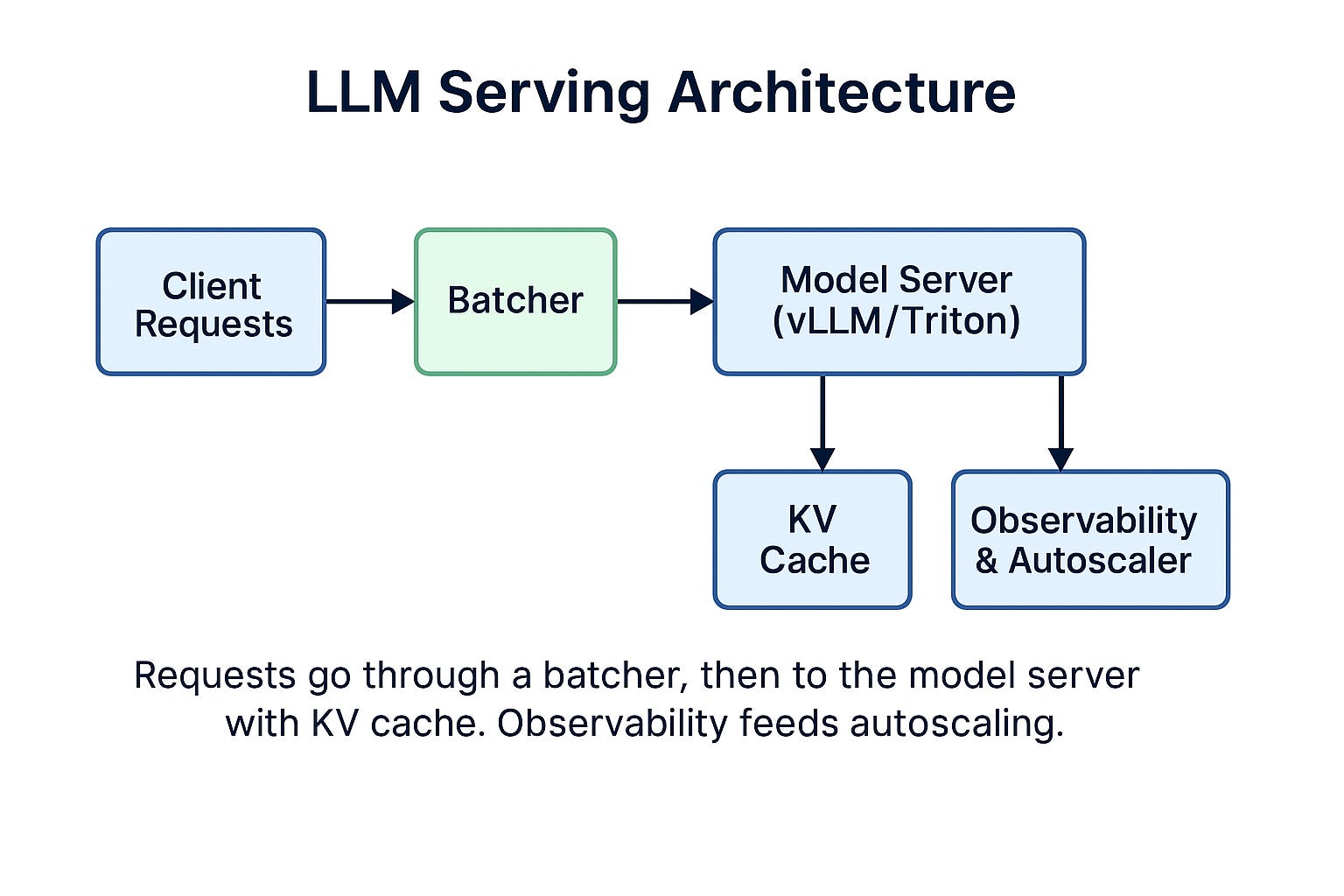
Trade-offs to Know
Batching vs Latency: Great for throughput, but adds wait time.
Quantization vs Quality: INT4 saves cost but can hurt accuracy.
KV Cache vs Memory: Faster inference, but eats GPU memory.
Autoscaling vs Stability: Aggressive scaling can cause cold starts.
Actionable Steps
Enable dynamic batching in your serving stack.
Add KV cache for long prompts.
Test INT4 or FP8 quantization on your eval set.
Use autoscaling with warm pools.
Track GPU utilization and p95 latency.
References
vLLM GitHub
Triton Inference Server
From my experience: batching + quantization gave 50% cost drop in one project.
Subscribe for weekly AI infra deep dives.