Your production pipeline just died. Again.
It happened at 3:00 AM because a data validation step in your Airflow DAG caught a distribution shift in a primary feature. The pipeline did exactly what you told it to do: it halted. It sent an alert. Now, a tired engineer has to wake up, spin up a notebook, manually investigate the drift, determine if it’s a seasonal anomaly or a broken upstream sensor, and decide whether to trigger a retraining run or manually override the validation threshold.
This is the “deterministic sequence” trap. We’ve spent a decade building rigid, linear pipelines that are great at executing known steps but paralyzed by the unknown.
The shift we’re seeing now, the “agentic shift”, is the move from these static DAGs to goal-directed reasoning. Instead of a sequence of steps, you define an objective. Instead of a failed validation step halting the world, an agentic system detects the drift, autonomously spins up a diagnostic environment, analyzes the root cause, and proposes a retraining strategy for a human to approve.
We’re moving from the Model as a Component to the Model as a Controller.
The Death of the Static DAG
Airflow and Kubeflow have been the gold standards for years. They’re fantastic for ETL and basic ML orchestration because they provide a clear, immutable path from raw data to a deployed pickle file. But real-world data is volatile.
Linear pipelines struggle because they assume the environment is static between the time the DAG is written and the time it executes. When a feature drifts or a schema changes, the DAG doesn’t “reason” about it; it just crashes (which, let’s be honest, is just a fancy way of saying “it broke”). You’ve essentially built a very expensive Rube Goldberg machine. If one marble falls off the track, the whole thing stops.
The agentic shift changes the fundamental unit of work. We’re moving from stateless prompts, where you ask an LLM to summarize a log, to autonomous goal-setting.
In a traditional pipeline, the model is just a node in the graph. In an agentic architecture, the model is the graph. It looks at the state of the system, selects a tool (like a feature store query or a training script), observes the output, and decides the next step.
Architecture: From Monolithic Pipelines to Agentic Microservices
If you’re designing AI architectures for 2026, stop thinking in terms of “pipelines” and start thinking in terms of “event-driven agentic microservices.”
Basically, the architecture is built around the Reason-Act-Observe loop. Instead of a hard-coded sequence, the agent operates in a cycle:
Reason: “The p99 latency of the model has spiked, and the drift detector is flagging the ‘user_age’ feature.”
Act: “I’ll query the Feature Store to compare the last 24 hours of data against the training baseline.”
Observe: “The mean age has shifted from 34 to 12. This looks like a bot attack on the signup page.”
Reason (Iterate): “I shouldn’t retrain the model on this corrupted data. I’ll instead trigger a circuit breaker to filter out traffic from the offending IP range and alert the security team.”
Here’s how that flow looks visually:
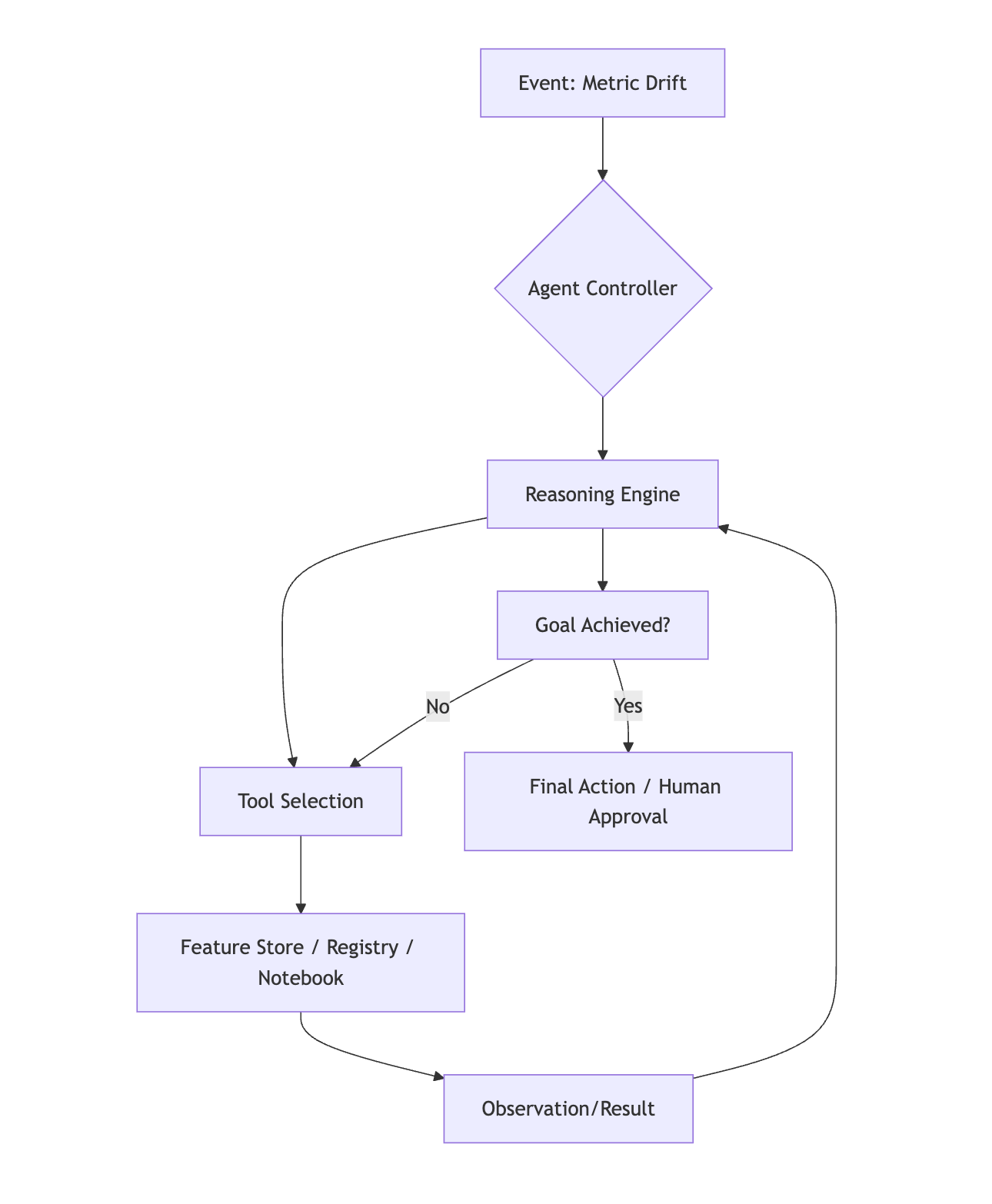
It’s a move from prompt-driven triggers (“If X happens, do Y”) to autonomous sub-goal decomposition. The agent doesn’t just run a script; it breaks the high-level goal (“Fix the model drift”) into smaller, manageable tasks (“Analyze feature X,” “Check data lineage,” “Test new hyperparameters”).
This requires your ML artifacts, feature stores, model registries, and training clusters, to be exposed as tools (APIs) that an agent can call. If your model registry is just a UI for humans to click buttons, your agent is useless. It needs a programmatic interface to “promote” a model or “tag” a version.
Practical Application: Autonomous EDA and Hyperparameter Tuning
Let's get concrete. Where does this actually beat a standard Scikit-Learn pipeline?
Autonomous EDA and Leakage Detection
I once worked with a team that spent three weeks optimizing a churn model, only to realize during the final validation that they had a massive data leak: a "churn_date" column had accidentally leaked into the training set. The model had 99% accuracy, which should have been a red flag, but the team was too focused on the leaderboard to notice.
Replacing GridSearch with Reasoning
Manual GridSearch or even Bayesian optimization is essentially "blind" searching. You're optimizing a number without understanding
Code Pattern: LangGraph + Scikit-Learn
Using a framework like LangGraph allows you to maintain state across these iterations. Here's a simplified pattern for an agent that decides whether to retrain a model based on a performance check.
from langgraph.graph import StateGraph, END
from typing import TypedDict

class AgentState(TypedDict):
    metric_value: float
    threshold: float
    action_taken: str
    iteration: int

def check_performance(state: AgentState):
    # Logic to query model registry/monitoring
    if state['metric_value'] < state['threshold']:
        return {"action_taken": "retrain", "iteration": state['iteration'] + 1}
    return {"action_taken": "maintain", "iteration": state['iteration'] + 1}

def execute_retraining(state: AgentState):
    # Call to your training pipeline (e.g., Kubeflow pipeline)
    print("Triggering SageMaker training job...")
    return {"action_taken": "retrained", "metric_value": 0.92} # Mocked new metric

# Define the graph
workflow = StateGraph(AgentState)

workflow.add_node("monitor", check_performance)
workflow.add_node("train", execute_retraining)

workflow.set_entry_point("monitor")

# Conditional edge: if action is 'retrain', go to train node; else, end.
workflow.add_conditional_edges(
    "monitor",
    lambda x: x["action_taken"],
    {
        "retrain": "train",
        "maintain": END
    }
)

workflow.add_edge("train", "monitor")

app = workflow.compile()
# Run the agent
app.invoke({"metric_value": 0.81, "threshold": 0.90, "iteration": 0})
Myths vs. Reality: The Autonomy Paradox
You might be thinking:
Myth: Agents replace the ML Engineer. Reality: They shift the role. You stop being the person who writes the
bashscripts to glue together Python files and start being a System Architect. Your job becomes defining the “guardrails” and the “objective functions” the agent optimizes for.Myth: Agentic systems are too non-deterministic for production. Reality: You don’t give the agent the keys to the kingdom. You use “Guardrail Agents”, separate, deterministic LLM calls or hard-coded checks, that validate the agent’s proposed plan before it executes. The agent proposes the
git commit; a human or a CI/CD pipeline approves it.Myth: The cost of reasoning tokens is too high. Reality: Compare the cost of 10,000 tokens (roughly the price of a mediocre coffee) to the cost of a senior MLE spending four hours debugging a pipeline failure. Not even close.
The Fragility of Agency: Trade-offs and Failure Modes
I'll be honest: agentic microservices are often just a fancy name for a distributed system with a non-deterministic controller. For 90% of production pipelines, a well-defined state machine is more reliable and significantly cheaper.
The Infinite Loop: Agents can hallucinate a path to a goal that doesn’t exist. They might try to “fix” a data drift by retraining the model, see that the drift persists (because the data is actually broken upstream), and decide to retrain again. And again. Without a “max_iterations” hard cap, you’ll wake up to a $5,000 AWS bill for training jobs that did nothing.
State Management Overhead: In a multi-agent system, keeping the “source of truth” consistent is a nightmare. If the “EDA Agent” finds a bug but the “Training Agent” isn’t updated on that discovery, you’re just automating the production of garbage.
Autonomous Drift: This is the most dangerous failure mode. An agent optimizes for a metric (e.g., F1-score) but does so by exploiting a quirk in the data that diverges from business value. If the agent discovers that ignoring all “low-value” users spikes the accuracy, it will do it.
Automating EDA and tuning is a distraction if you haven't nailed your objective function. An agent is a force multiplier; if your goal is slightly off, the agent will just help you move in the wrong direction faster. Pure chaos.
The End of the Pipeline
By 2027, the "ML Pipeline" as a concept will be obsolete.