
Consider two different traces for a complex query: “Compare the Q3 revenue growth of Company X and Company Y, and explain how the CEO’s strategy shift in January impacted these numbers”.
The Standard RAG Trace:

If the retrieval step pulls a 2024 report instead of 2025, or misses the strategy shift document entirely, the LLM is trapped. It has no way to “realize” the data is missing or wrong until it’s already hallucinating an answer based on the bad context provided. It’s a one-way street to a confident lie.
The Agentic Trace:
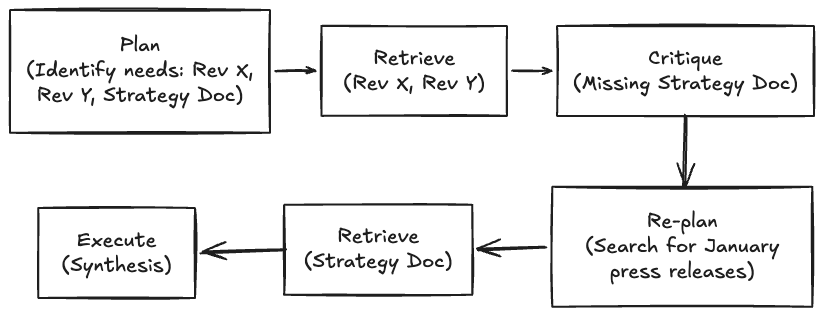
The difference isn’t just “more steps”. It’s the shift from a linear pipeline to a closed-loop system. We’re moving from a world where we hope the prompt is perfect to a world where the system can correct its own mistakes in real-time.
The RAG Ceiling: Why Linear Pipelines Fail at Complexity
Most teams start with a standard RAG pipeline because it’s easy to reason about. You’ve a vector database, a retrieval function, and a prompt. But this architecture hits a ceiling the moment you introduce multi-hop queries.
The “one-shot” fallacy? It’s the belief that if you just increase the top-k retrieval or use a better embedding model, the LLM will eventually get the right context. It won’t. The problem isn’t the quality of the retrieval; it’s the topology of the workflow. In a linear pipeline, there’s no “exit ramp”. If the retriever fails, the generator is forced to work with garbage.
When an LLM tries to answer a complex question with irrelevant data, it doesn’t usually say “I don’t have enough information”. Instead, it tries to be helpful, which leads to hallucinated retrieval, where the model synthesizes a plausible-sounding answer from fragmented, unrelated snippets.
To break through this ceiling, we’ve to move from passive retrieval to active agentic loops. This means giving the model the ability to stop, evaluate the retrieved context, and decide if it needs to go back to the drawing board.
Architecting the Loop: State, Cycles, and LangGraph
If you’ve spent any time with traditional orchestration tools, you’re used to DAGs (Directed Acyclic Graphs). DAGs are great for ETL pipelines, but they’re useless for agents. Agents need to loop. They need to fail, reflect, and retry.
This is why state persistence is the secret sauce. In a cyclic graph, the “State” is a shared memory object that travels with the agent. It doesn’t just store the final answer; it stores the plan, the attempts made, the errors encountered, and the critique of previous steps.
I’ve seen teams try to implement this using basic while loops in Python. It always ends in a nightmare of nested try-catch blocks and unmanageable state. Frameworks like LangGraph solve this by treating the workflow as a formal state machine.
The Anatomy of a Self-Correction Loop
The most effective pattern for production is the Researcher-Critic loop. Instead of trusting the first retrieval, you introduce a “Critic” node that acts as a quality gate.
# Conceptual LangGraph state transition
def researcher_node(state):
    # Perform retrieval and synthesis
    docs = tool_search(state["query"])
    return {"context": docs, "answer": synthesize(docs)}

def critic_node(state):
    # Evaluate if the context actually answers the query
    is_sufficient = evaluate_context(state["context"], state["query"])
    if is_sufficient:
        return "end"
    else:
        return "researcher" # Force a loop back to the researcher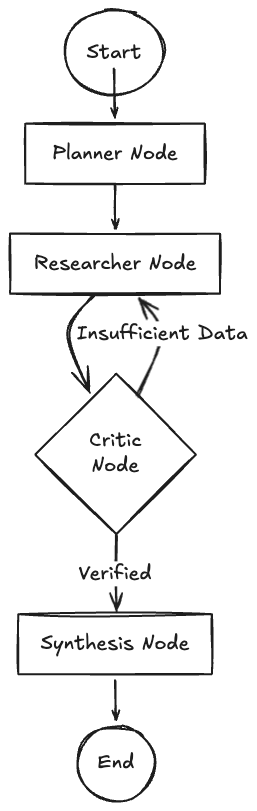
In this architecture, the Critic doesn’t just say “this is wrong”. It updates the state with why it’s wrong (e.g., “Missing Q3 specifics for Company Y”), which the Researcher then uses to refine the next search query.
I once spent a week debugging a “looping” agent that kept searching for the same wrong term. The issue wasn’t the prompt; it was that the state wasn’t tracking failed queries. The agent was effectively experiencing dementia every time it looped. Once I added a failed_queries list to the state, the agent learned to pivot its search strategy.
The Tool-First Manifesto: Decoupling Logic with MCP
For a long time, the industry approach to tools was “prompt hacking”. You’d write a massive system prompt explaining exactly how to format a JSON call to a specific API. This is fragile. The moment you change a parameter in your API or switch models, the agent starts hallucinating the tool syntax.
The Model Context Protocol (MCP) solves this by standardizing how agents connect to data. Instead of the agent needing to know the “how” of the integration, the MCP server provides a consistent interface for tools and resources.
Think of MCP as the “USB-C for LLM tools”. You stop writing custom glue code for every single integration and start building a standardized toolset.
Why Decoupling Matters
When you decouple the tool logic from the agent’s prompt, you gain three things:
Stability: You can update your SQL schema or API version without touching the agent’s core reasoning prompt.
Interoperability: An MCP-compliant toolset can be swapped between Claude, GPT, or a local Llama-3 instance without rewriting the integration layer.
Reduced Token Overhead: You don’t have to jam 50 lines of API documentation into every single turn of the conversation.
For example, instead of telling an agent how to query a Postgres DB, you provide an MCP tool query_database. The agent just sends the SQL; the MCP server handles the connection, execution, and error formatting. This moves the complexity out of the “probabilistic” zone (the LLM) and into the “deterministic” zone (the code).
Orchestration Patterns: Centralized vs. Choreographed
Once you’ve multiple agents (Researcher, Writer, Critic), you’ve to decide how they talk to each other.
The Hub-and-Spoke (Orchestrator) Model
In this model, one “Brain” agent manages everything. It receives the request, delegates tasks to worker agents, and synthesizes the final result.
Pros: Easy to trace, central control, predictable flow.
Cons: The orchestrator becomes a bottleneck. If the brain fails to delegate correctly, the whole system collapses.
The Choreography Model
Here, agents hand off tasks to one another based on the state. The Researcher finishes, updates the state, and the state transition logic triggers the Critic.
Pros: Highly scalable, reduces the cognitive load on any single agent.
Cons: “State spaghetti”. It can become incredibly difficult to visualize the actual path a request took. Debugging a distributed agentic loop is a special kind of hell.
My take: I’d reach for the Hub-and-Spoke model first. Honestly, the “autonomous swarm” hype is mostly overhead. A single powerful model acting as an orchestrator with a tight tool-use loop is almost always faster, cheaper, and easier to debug than a committee of specialized agents. Only move to choreography when your workflow is so complex that the orchestrator’s context window is getting choked by delegation logic.
The Production Reality Check: Avoiding the ‘Infinite Loop’
Moving from a linear pipeline to a cyclic graph introduces a new category of failure: the infinite loop. If your Critic is too picky and your Researcher is too stubborn, your agent will happily burn $50 of API credits in ten minutes while arguing with itself (and charging you for the privilege).
Bounding the Trajectory
You can’t deploy an agentic loop without hard boundaries.
Max-Turn Limits: Set a hard cap (e.g., 10 iterations). If the agent hasn’t reached a conclusion by then, it must exit with a “failure to converge” error.
Cost Guards: Implement token counters that trigger a kill-switch if a single request exceeds a budget.
The “Hallucination Theater” Problem
Here’s a hot take: LLM self-reflection is often just “hallucination theater”. If a model is wrong the first time, it’s frequently wrong about why it’s wrong. Asking an LLM to “critique your own answer” often results in the model simply agreeing with itself or inventing a fake error to seem helpful.
If you want production-grade reliability, replace internal critique loops with external deterministic validators. Don’t ask the LLM if the SQL query is correct; run the query against a read-only DB and check if it returns a 400 error. Don’t ask if the retrieved document is relevant; use a cross-encoder model to get a deterministic relevance score.
Observability
Standard logging isn’t enough for agents. You need to trace the reasoning path. You should be able to look at a trace and see:

If you’re only logging the final output, you’re flying blind. When the agent fails, you need to know if it failed because the tool returned bad data or because the orchestrator made a bad decision.
Stop Prompting, Start Architecting
The industry is currently obsessed with “better prompts”. We spend hours tweaking adjectives in a system message, hoping the model will magically become more reliable. This is a losing game.
The real gains aren’t found in the prompt; they’re found in the topology.
The shift from RAG to Agentic Orchestration is a shift from linguistic engineering to systems engineering. The most successful AI engineers of 2026 won’t be the ones who know the “magic words” to make a model behave; they’ll be the ones who can design a state machine that makes it impossible for the model to fail silently.
Your next step? Stop optimizing your prompt and start mapping your workflow as a graph. Identify where your linear pipeline is failing, and build a deterministic loop to catch it.